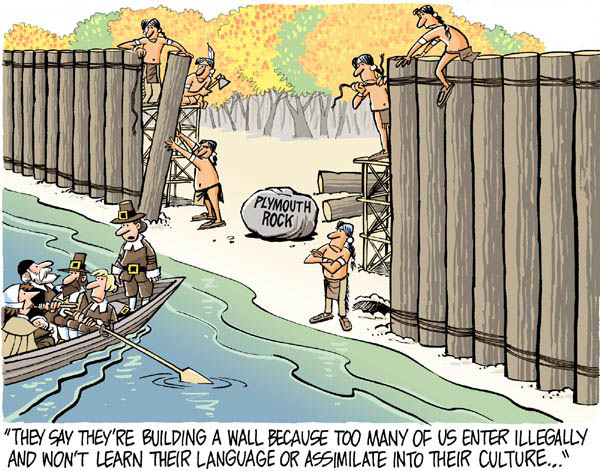
Cartoons about Indians and Pilgrims constitute a genre of their own, and the conflict they depict tends to follow a pattern: they turn large cultural conflicts into a comedy of manners.
I thought about this recently when I saw one of these cartoons, by David Sipress, in The New Yorker. It is an example of what Henri Bergson would have called "the reciprocal interference of independent series."
Although Bergson wrote "Laughter: An Essay on the Meaning of the Comic" (in 1900), you can tell from his writing style that he did not invent the term "ROFL."
Although Bergson wrote "Laughter: An Essay on the Meaning of the Comic" (in 1900), you can tell from his writing style that he did not invent the term "ROFL."
Bergson was describing stage comedies when he coined that phrase, but it is a principle that applies to many cartoons, especially those in The New Yorker. (Look in the magazine's online Cartoon Bank under the heading of "Thanksgiving.") He is describing comical dramatic situations that exist among different sets of characters. When those different sets meet, the audience realizes that "the actions and words that belong to one might just as well belong to the other." (This is evident in several of Shakespeare's plays, for example, when the plot of the upper-class characters is mirrored in the plot of the lower-class characters.) But for cartoons, the common dynamic is that a statement (the caption) totally appropriate in one situation is placed in a situation that, at first, seems inappropriate -- until the reader realizes it is uncannily appropriate.
He also describes an example that could be applied to this particular category of cartoons, Indians & Pilgrims. Bergson writes that comedy can ensue when we witness the combination of "one series of events belonging to the past and another belonging to the present."
 Another New Yorker example of humor arising from this juxtaposition is a recent Thanksgiving cover that illustrates the common analogy between current debates about "illegal immigrants" and Pilgrims.
 Another New Yorker example of humor arising from this juxtaposition is a recent Thanksgiving cover that illustrates the common analogy between current debates about "illegal immigrants" and Pilgrims.
At the heart of this comedy (and of much comedy) is incongruity. The audience realizes these things do not belong together, which produces an element of surprise, but the audience also realizes there are some startling similarities, which produces another element of surprise.
In Sipress's cartoon, we have an event that might be experienced today, when a stretch of beach is reserved for the use by residents of that community. Then there is the awkward encounter when someone must tell the unwelcome visitors that they must leave.
Today is juxtaposed with the past when this moment of summer beach "trespassing" is made analogous to the arrival of Europeans in New England. However, the awkwardness comically alluded to here is epic rather than quotidian. The trespassing tourists in this case, we know from our history books, stay and eventually take possession of the beach. (Smallpox Beach Towels for Everyone!)
Sipress's image interested me not simply because it touches on a common trope in modern cartoons but because it made me think about the truths it is built upon, truths that, depending upon your perspective, it acknowledges or avoids.
While Bergson tries to understand what makes some things funny, Avner Zev tries to understand what makes some funny things useful. In "Humor as a Social Corrective," Zev ponders a couple of possibilities for the social function of laughter. One idea is that laughter is a way to punish people who transgress social mores. This idea understands laughter as mostly mockery. Since few people enjoy receiving that kind of laughter, Zev writes, avoiding it will encourage people to conform to society's expectations.
A second idea, which Zev finds more attractive, is that laughter relieves social pressure. This release of pressure is especially important for people living in undesirable circumstances: In every repressive regime there is this kind of underground humor, and it fulfills an important function: Laughter shared by the oppressed as the expense of the oppressor reduces fear and helps people to go on living under the regime with more ease.
We do not need to discuss repression to discuss the pressure-release theory of laughter. Many forms of laughter acknowledge a real social problem while at the same time allowing the audience to laugh about the situation; indeed, the laughter may allow the acknowledgement to take place, since without it the discomfort of the problem would create the incentive to avoid the topic. And there are times when a group of oppressed people make serious critiques of their oppressors in the form of jokes. They are allowed to make a forbidden comment ("You suck"), but pass it off as a joke; the oppressor may not realize the jokers were not joking. If the comment had not been disguised as a joke, it could never have been made -- the Trojan Horse becomes a kind of Trojan Rubber Chicken.
But one problem with applying Zev's idea to this cartoon is that it appears in The New Yorker, not Indian Country Today. What social pressure is being relieved when cartoons like this appear in a magazine the is closely associated with elite members of the dominant culture?
Zev says humor can allow an oppressed group of people "go on living under the regime with more ease," but, on the flipside, humor can allow a dominant group of people go on living despite the injustice of a system or event from which it benefits. The joke acknowledges a sense of guilt without changing anything.
Cartoons such as Sipress's acknowledge the problem with land claims made by the dominant culture -- in this case, the United States of America, which considers itself descended from those Pilgrims depicted in the cartoons who landed at Plymouth in 1620 (never mind the Englishmen who had been in Virginia since 1607). The beach is for residents only, the Indian man tells them, which mirrors current regional laws that limit such beach use to local residents. But we know from history that these interlopers do not go away, despite the legitimacy of the Indian's claims; hence, their claim to own the beach today is dubious.
Cartoons make this tacit confession, and yet the news frequently contains examples of the United States denying the legitimacy of land claims by American Indians, even those land claims that have moved successfully through the legal system created by the United States.
The irony of Sipress's cartoon came to mind because I had just seen two articles about American Indian land claims.
I saw an article about Sen. Richard Blumenthal of Connecticut renewing his opposition to changes in the process by which American Indian tribes are granted federal recognition. He gained his fame as the state's attorney general and for his role in reversing federal recognition of two tribes in Connecticut (those reversals were unprecedented). If those tribes had gained federal recognition, they could have expanded their land bases, which would have meant a loss of land for those currently occupying it.
I also saw an article about the Agua Caliente tribe in Palm Springs, Calif., taking action against the water district there. The Agua Caliente are asserting the legality of their claim to those water rights and claiming the water district is abusing and contaminating the water supply. While this case is just getting started, I will not hold my breath for the court system to rule in favor of the Agua Caliente.
Don't get me wrong: I love cartoons. That is one reason I subscribe to The New Yorker, and the door to my campus office is covered in them. And I love to laugh, even at very serious topics. But I do think it is useful to keep in mind the issues raised (and buried) by our laughter.
We do not need to discuss repression to discuss the pressure-release theory of laughter. Many forms of laughter acknowledge a real social problem while at the same time allowing the audience to laugh about the situation; indeed, the laughter may allow the acknowledgement to take place, since without it the discomfort of the problem would create the incentive to avoid the topic. And there are times when a group of oppressed people make serious critiques of their oppressors in the form of jokes. They are allowed to make a forbidden comment ("You suck"), but pass it off as a joke; the oppressor may not realize the jokers were not joking. If the comment had not been disguised as a joke, it could never have been made -- the Trojan Horse becomes a kind of Trojan Rubber Chicken.
But one problem with applying Zev's idea to this cartoon is that it appears in The New Yorker, not Indian Country Today. What social pressure is being relieved when cartoons like this appear in a magazine the is closely associated with elite members of the dominant culture?
Zev says humor can allow an oppressed group of people "go on living under the regime with more ease," but, on the flipside, humor can allow a dominant group of people go on living despite the injustice of a system or event from which it benefits. The joke acknowledges a sense of guilt without changing anything.
Cartoons such as Sipress's acknowledge the problem with land claims made by the dominant culture -- in this case, the United States of America, which considers itself descended from those Pilgrims depicted in the cartoons who landed at Plymouth in 1620 (never mind the Englishmen who had been in Virginia since 1607). The beach is for residents only, the Indian man tells them, which mirrors current regional laws that limit such beach use to local residents. But we know from history that these interlopers do not go away, despite the legitimacy of the Indian's claims; hence, their claim to own the beach today is dubious.
Cartoons make this tacit confession, and yet the news frequently contains examples of the United States denying the legitimacy of land claims by American Indians, even those land claims that have moved successfully through the legal system created by the United States.
The irony of Sipress's cartoon came to mind because I had just seen two articles about American Indian land claims.
I saw an article about Sen. Richard Blumenthal of Connecticut renewing his opposition to changes in the process by which American Indian tribes are granted federal recognition. He gained his fame as the state's attorney general and for his role in reversing federal recognition of two tribes in Connecticut (those reversals were unprecedented). If those tribes had gained federal recognition, they could have expanded their land bases, which would have meant a loss of land for those currently occupying it.
I also saw an article about the Agua Caliente tribe in Palm Springs, Calif., taking action against the water district there. The Agua Caliente are asserting the legality of their claim to those water rights and claiming the water district is abusing and contaminating the water supply. While this case is just getting started, I will not hold my breath for the court system to rule in favor of the Agua Caliente.
Don't get me wrong: I love cartoons. That is one reason I subscribe to The New Yorker, and the door to my campus office is covered in them. And I love to laugh, even at very serious topics. But I do think it is useful to keep in mind the issues raised (and buried) by our laughter.